


 |
2000L Jacketed Liquid Mixing System with Heating and Cooling Temperature Control
Product Details:
| Place of Origin: | CHINA |
| Brand Name: | CHONGYANG |
| Certification: | ISO,CE |
| Model Number: | CY-JLMS-2000L |
Payment & Shipping Terms:
| Minimum Order Quantity: | 1 |
|---|---|
| Price: | Negotiation |
| Packaging Details: | Export Standard Wooden Box |
| Delivery Time: | 15 Days |
| Payment Terms: | T/T, L/C |
| Supply Ability: | 100 sets/Month |
|
Detail Information |
|||
| Capacity: | 300L / 500L / 1000L / 2000L / 3000L / Custom | Material: | SS316L (Product Contact Parts), SS304 (Frame) |
|---|---|---|---|
| Surface Finish: | Ra ≤ 0.8 μm | Agitator Configuration: | Propeller / Paddle / Anchor |
| Application: | Cream, Lotion, Gel, Emulsion, Viscous Liquid | Emulsification: | High-Shear Emulsifying |
| Vacuum System: | Available | Heating / Cooling: | Jacketed |
| Transfer: | Sanitary Pump | Cleaning: | CIP-Ready |
| Control: | Manual / Automatic | Installation: | Skid-Mounted / Customized |
| Customization: | Available | ||
Product Description
2000L Jacketed Liquid Mixing System with Heating and Cooling Temperature Control
2000L Jacketed Liquid Mixing System for Temperature-Controlled Batch Processing
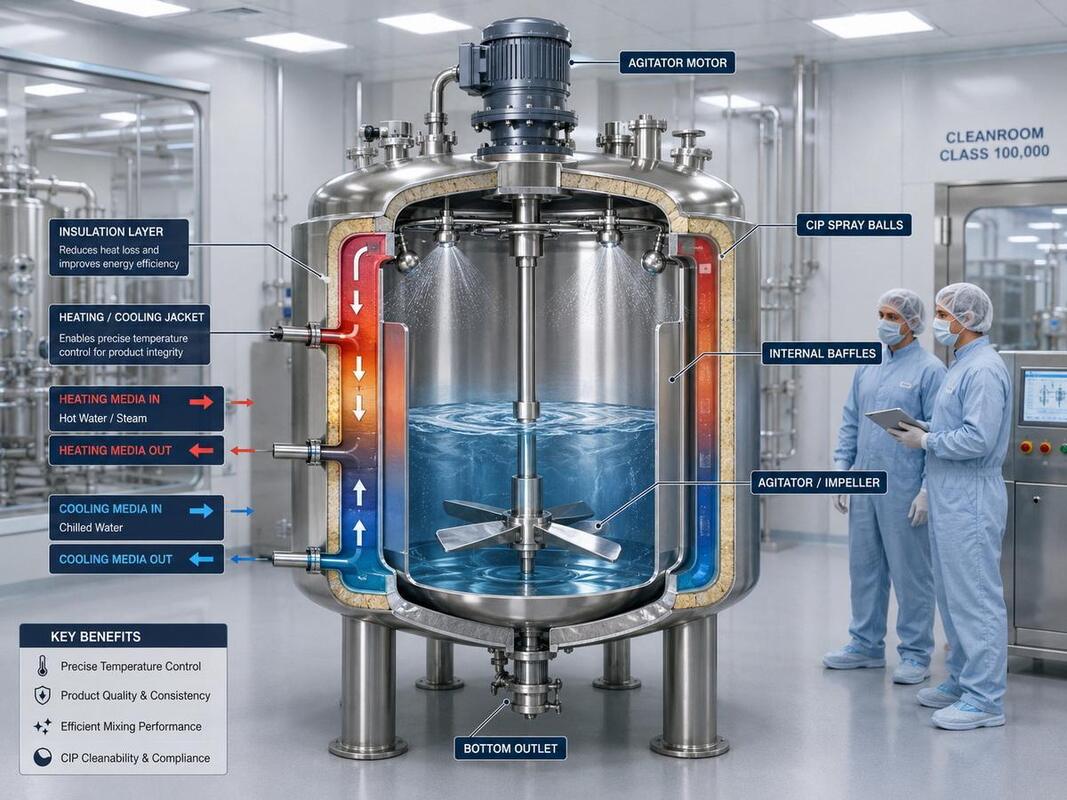
The 2000L Jacketed Liquid Mixing System is designed for industrial liquid preparation processes requiring controlled mixing, heating, cooling and temperature monitoring.
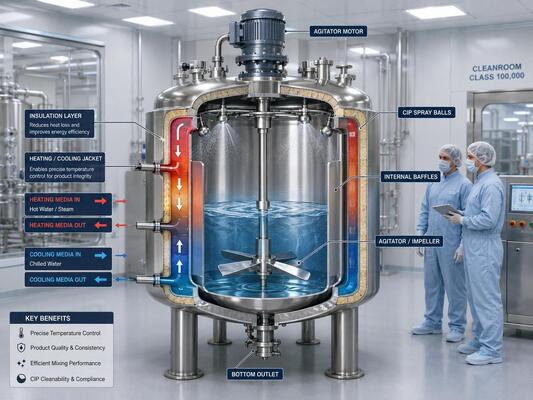
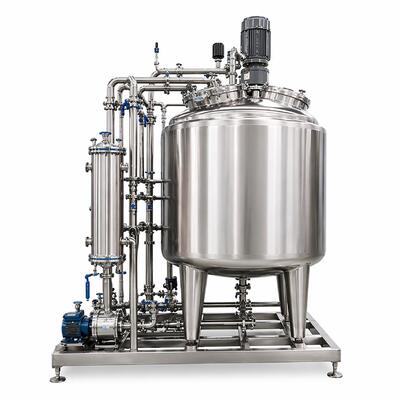
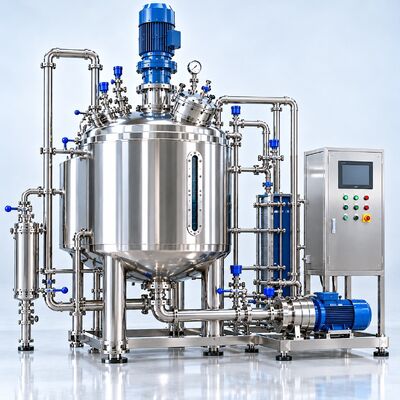
The system incorporates an SS316L product-contact mixing vessel with an external heating and cooling jacket. A variable-speed agitator provides bulk liquid circulation, while the jacket transfers heat between the processing liquid and the selected heating or cooling medium.
Depending on the formulation and process requirements, the system can be configured for liquid blending, ingredient dissolution, temperature-controlled holding, heating-assisted mixing and controlled cooling before downstream transfer.
Compared with a conventional single-wall mixing tank, a jacketed mixing system provides an additional level of thermal process control without direct contact between the utility medium and the product.
Typical Temperature-Controlled Mixing Process Flow
Charging
Dosing
Temperature Control
Mixing
Holding
Cooling
Transfer
Typical batch process. Heating, holding and cooling stages can be adjusted or omitted according to the formulation.
01. Liquid Base Charging
The required liquid base is introduced into the mixing tank according to the batch formulation and target working volume.
02. Ingredient Dosing
Liquid ingredients or compatible soluble additives are introduced in a controlled sequence. The agitator maintains circulation to support uniform blending.
03. Heating and Temperature Control
Hot water or another suitable heating medium circulates through the external jacket to raise the product temperature toward the required process setpoint.
04. Variable-Speed Mixing
The agitator provides bulk circulation to improve temperature distribution and ingredient uniformity. Mixing speed is selected according to viscosity and process requirements.
05. Temperature Holding
Where required, the control system maintains the product within a specified temperature range for the necessary processing or holding period.
06. Controlled Cooling
Cooling water or chilled water can be circulated through the jacket to reduce product temperature before transfer or storage.
07. Product Transfer
The prepared liquid is discharged through a sanitary outlet and transferred by a suitable pump to downstream storage, filtration or filling equipment.
Heating and Cooling Jacket — Working Principle
The jacket is one of the most important components of the 2000L temperature-controlled mixing system. It allows indirect heat exchange between the processing liquid and the heating or cooling medium.
Jacketed Heating
Hot water or another suitable heating medium circulates through the external jacket. Heat passes through the vessel wall into the liquid, while the agitator supports bulk circulation and temperature distribution.
Jacketed Cooling
Cooling water or chilled water flows through the jacket to remove heat from the product. Cooling performance depends on the heat transfer area, utility temperature, flow rate and liquid properties.
Heating Circuit → Heat Input & Temperature Increase
Cooling Circuit → Heat Removal & Temperature Reduction
Variable-Speed Agitator → Liquid Circulation & Temperature Distribution
Temperature Control Design Considerations
The heating and cooling configuration should be selected according to actual process conditions rather than using a fixed jacket design for every liquid preparation application.
Actual liquid volume and density.
Initial and target process temperatures.
Specific heat capacity and viscosity.
Required batch processing duration.
Heating and cooling medium conditions.
Heat transfer area and design rating.
Circulation and wall-side heat transfer.
Temperature monitoring and regulation.
For higher-viscosity liquids, additional consideration should be given to circulation near the vessel wall and overall heat transfer performance.
Main Features
Suitable for medium-to-large liquid preparation batches.
Corrosion-resistant construction with hygienic contact surfaces.
Indirect thermal control during batch processing.
Supports bulk liquid circulation and uniform mixing.
Optional PT100 sensor and automatic temperature control.
Optional insulation for reduced heat loss and operator protection.
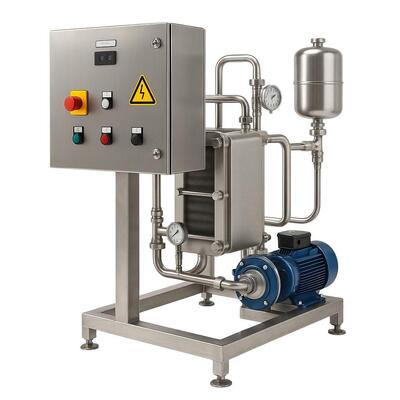
Sanitary outlet, pump and hygienic piping for downstream processing.
Cleaning spray devices and drainable connections can be incorporated.
Optional control of mixing, temperature, holding time and transfer.
Typical Technical Parameters
| Parameter | Typical Specification |
|---|---|
| Model | CY-JLMS-2000L |
| Nominal Capacity | 2000 L |
| Product Contact Material | SS316L |
| External Material | SS304 / Customized |
| Internal Surface Finish | Ra ≤ 0.8 μm |
| Main Agitator | Variable Speed |
| Agitator Type | Propeller / Paddle / Anchor |
| Heating | External Jacket |
| Cooling | External Jacket |
| Heating Medium | Hot Water / Steam |
| Cooling Medium | Cooling Water / Chilled Water |
| Temperature Sensor | PT100 / Customized |
| Temperature Control | Manual / Automatic |
| Thermal Insulation | Optional |
| Level Monitoring | Optional |
| Transfer Pump | Sanitary Type |
| Cleaning | CIP-Ready |
| Control System | Manual / PLC-HMI |
| Installation | Standalone / Skid-Mounted |
| Capacity Customization | Available |
Engineering Note: Final heating/cooling duty, jacket pressure rating, utility connections, agitator power, operating speed and temperature-control arrangement must be confirmed according to the formulation and process design conditions.
Typical Applications
The 2000L jacketed liquid mixing system can be configured for various industrial liquid preparation applications requiring controlled temperature and mixing.
Jacketed Mixing Tank vs. Conventional Mixing Tank
| Conventional Mixing Tank | Jacketed Mixing Tank |
|---|---|
| Primarily for liquid blending | Mixing with thermal process control |
| No integrated jacket by default | External heating/cooling jacket |
| Temperature may depend on incoming liquid | Controlled heating or cooling available |
| Suitable for ambient mixing | Suitable for temperature-controlled processes |
| Simpler utility requirements | Requires heating/cooling utilities |
| Lower system complexity | Additional instrumentation and thermal design |
How to Select the Right Jacketed Mixing System
Product Characteristics
Viscosity, density, specific heat capacity, ingredient compatibility and temperature sensitivity should be considered when selecting the vessel and agitator.
Working Volume
The effective working volume should be confirmed separately from the nominal 2000L tank capacity.
Heating Requirements
Initial temperature, target temperature, heating time and available utility conditions determine the heating duty.
Cooling Requirements
Target discharge temperature, cooling time and cooling medium temperature determine the cooling capacity.
Agitator Selection
Propeller, paddle or anchor agitators can be considered according to product viscosity and circulation requirements.
Temperature Control
Manual control or automatic temperature regulation can be selected according to required operating stability and production conditions.
Downstream Processing
Product transfer, filtration, buffer storage and filling requirements should be incorporated into the overall system design.
Recommended System Configuration
For higher automation requirements, the system can incorporate:
Automatic Heating/Cooling Sequence Control / Temperature Trend Monitoring / Mixing Time Control / Level Monitoring / Recipe-Based Batch Operation
Frequently Asked Questions
Can the same jacket be used for both heating and cooling?
Yes. A properly designed jacket can be connected to heating and cooling utility circuits with suitable valves, controls and operating sequences. Utility switching and jacket pressure/temperature ratings must be considered.
Can steam be used for jacket heating?
Yes, where the jacket is designed and rated for the steam conditions. Hot-water heating may be preferable for applications requiring gentler or more precise temperature control.
Does a 2000L tank always have a 2000L working volume?
No. Nominal capacity and effective working volume are different. The required working volume should account for mixing, liquid expansion, foam and operating freeboard.
Is an anchor agitator necessary?
Not always. Propeller or paddle agitation may be suitable for lower-viscosity liquids. Anchor-type agitation can be considered for more viscous products or applications requiring improved wall-side circulation.
Can automatic temperature control be integrated?
Yes. Temperature sensors, control valves and a PLC-HMI control system can be integrated according to the required process functions.
Customized 2000L Jacketed Liquid Mixing System
CHONGYANG WATER provides customized jacketed mixing solutions according to batch capacity, liquid viscosity, mixing requirements, target temperature, heating/cooling time and downstream production conditions.
Please provide your liquid type, working volume, viscosity, initial temperature, target heating/cooling temperature, available utilities and required batch processing time for system configuration and quotation.
